
If you spend much time on social media, you’ll hear the same arguments trotted out repeatedly for why lithium is a bad investment.
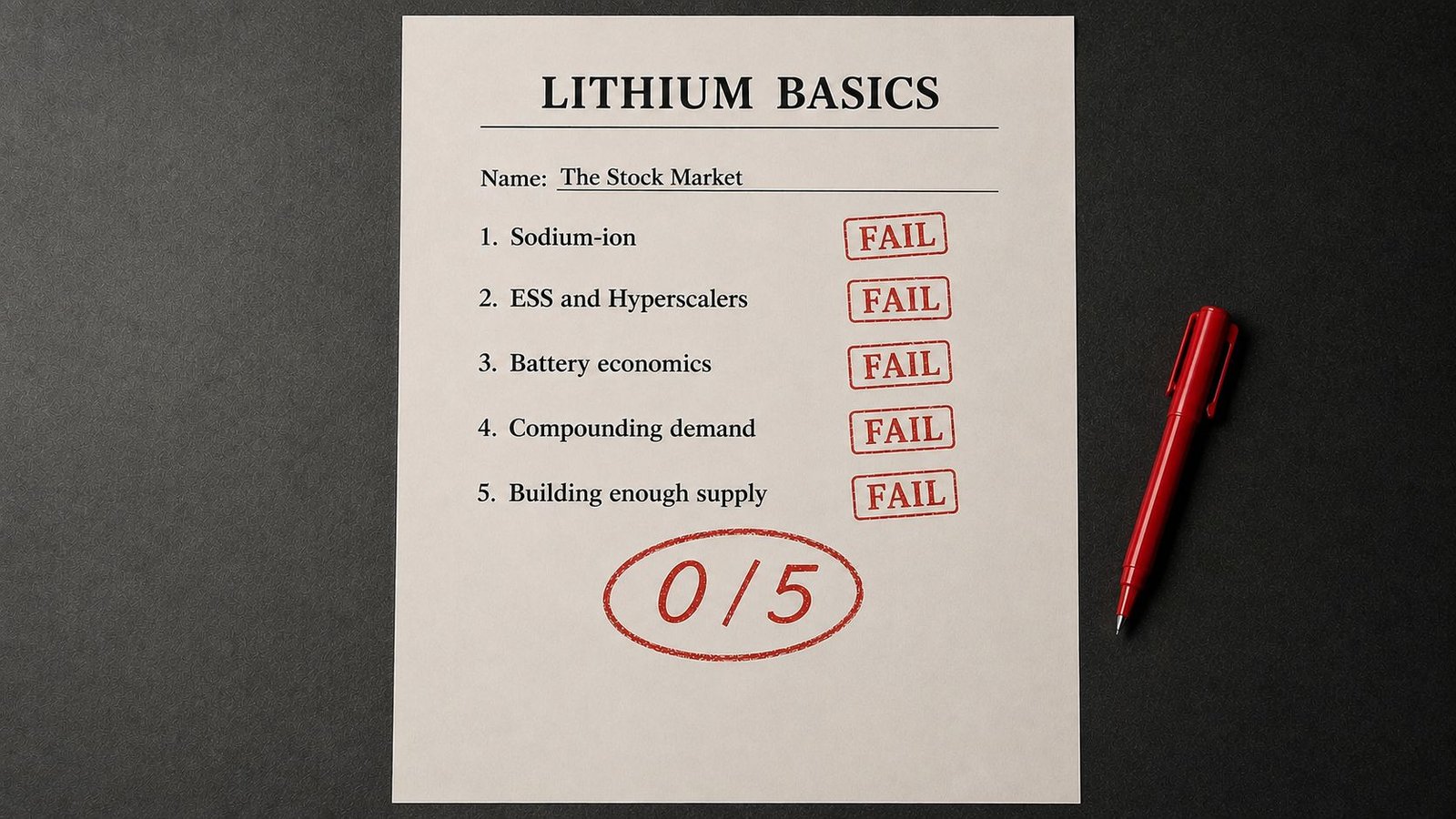
In this article, I explain why I believe the market is getting five key things wrong:
- Sodium-ion is a complementary technology, not a replacement for lithium-ion
- ESS demand is much bigger than just from hyperscalers
- The economics of lithium-ion batteries have fundamentally changed over the past decade
- The market is underestimating the arithmetic of compounding lithium demand
- Geological abundance does not automatically translate into producible lithium supply
Each of these points has important implications for the long-term outlook for lithium. Let’s look at them one by one.
1. Sodium-ion is complementary not a replacement technology
If I had a dollar for all the articles I’ve seen scaremongering about sodium-ion as a “replacement” for lithium-ion, I’d be a quite a lot richer at this point in time. It seems that whenever a bear is looking for something to beat the lithium market up about they head directly to sodium-ion.
Because, of course – according to the bears – sodium is much more plentiful in the Earth’s crust than lithium and therefore it makes sense to adopt sodium-ion.
<Sigh>
But most of these bears don’t really seem to understand very much about batteries.
Let’s start with energy density, which is the key to the argument on sodium-ion, in my view. This is something that a lot of the lithium bears out there just don’t seem to understand or even know about.
What is energy density? It’s the amount of energy that a cell or battery pack can store as a function of its weight or size. It can be measured in mass or volume terms but volumetric energy density is very important at the pack level because it determines how big a certain battery installation in an EV or ESS station needs to be.
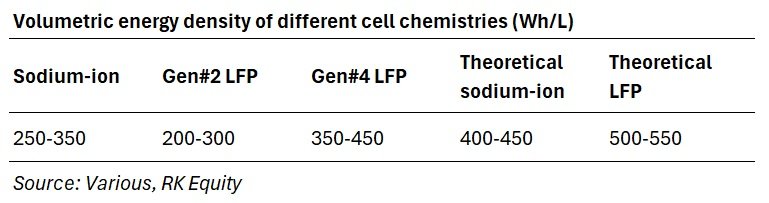
The energy density of sodium-ion cells is substantially lower than the energy density for fourth and fifth generation LFP.
What does that actually mean in practice? It means that to get the same amount of energy out of a current generation sodium-ion battery as out of a Gen#4 LFP, you need a lot more cells.
Think of it in this context; the current state of the art power output for a 20 foot container ESS utilising sodium-ion cells is 2.3-3.1MWh. Whereas for Gen#4 LFP cells it’s 6.0-6.25MWh. That means that you need 2-3x the number of sodium-ion containers as LFP containers in order to get the same output.
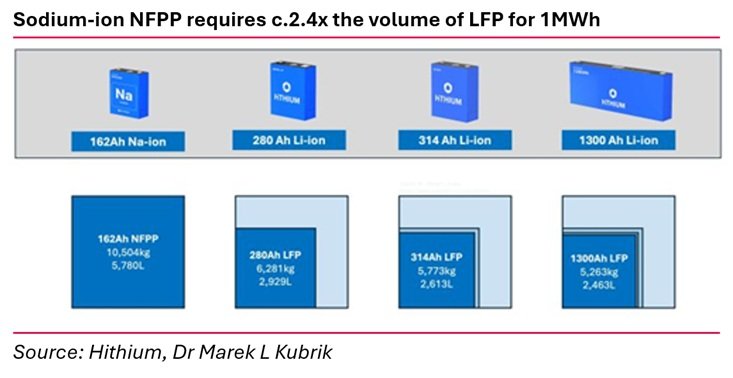
The analysis in the figure above was carried out in March 2026 by Marek Kubik, an ESS specialist, and concluded that state of the art sodium-ion cells utilising polyanionic cathode (NFPP) would be 2x heavier and 2.3x larger in volume than state of the art LFP batteries. As Kubik concludes “That’s a serious penalty to Balance of System costs”.
In EVs, where mass as well as volume are important, the difference is even more pronounced.
So the bottom line is that, even though sodium-ion cells have really good points about them, energy density is likely to be a key negative for them over a number of years. And, given the theoretical maximum for sodium-ion cells is less than for LFP, they may never be able to close that gap.
Now let’s move on to cell chemistry because this is really important and also seems to be ignored by most lithium bears when discussing sodium-ion.
I think there’s a perception amongst non-battery specialists that lithium or sodium are the key magic ingredients in cells. But they’re not. Lithium and sodium are the ions which move across the cells to make them work, but they’re not the only ingredients of a cell. In fact they’re a relatively small proportion of the mass of a cell.
A sodium-ion cell has an anode, a cathode, a separator and an electrolyte just like a lithium-ion one. While sodium is abundant, the other materials that are used to make those products may not be. For instance, I understand that CATL’s current generation sodium-ion cell uses a cathode which is a layered metal oxide, like ternary lithium-ion cells. It contains iron, manganese, nickel and TiO2, not all of which are abundant metals.
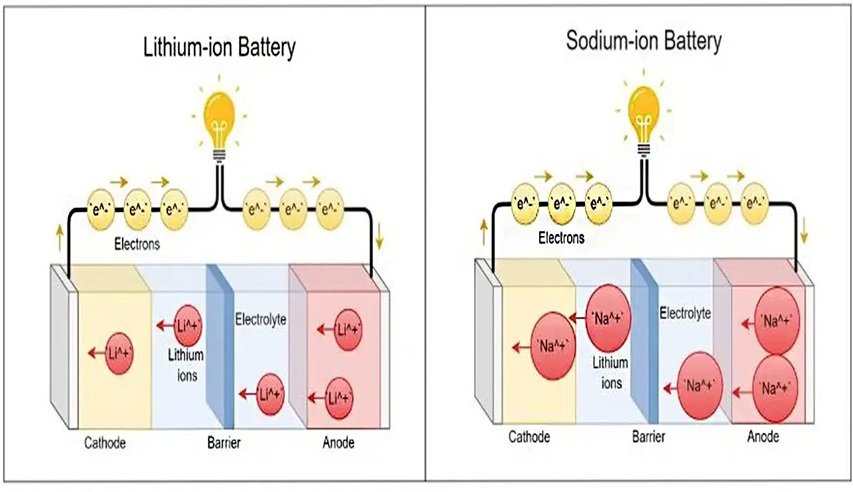
All sodium-ion cells use a hard carbon, not a graphite, anode. While there is sufficient hard carbon in production currently to support the limited commercial roll out of sodium-ion cells, there is not enough to support widescale substitution of sodium-ion for lithium-ion, in my view. Substantial further investment would be needed.
And finally, let’s talk about manufacturing cost because the supposed bottom line for sodium-ion is that – because sodium is so much more abundant than lithium – it’ll be cheaper to make these cells.
Apart from the fact that it’s not.
Because sodium-ion hasn’t scaled yet, it actually costs more to produce sodium-ion cells than LFP cells currently, and that’s even after the substantial increase in the cost of lithium-ion cells over the past 12 months.
An analysis by BCG in June this year concluded that the current Chinese factory cost for sodium-ion cells is c.US$60-70/kWh, while for LFP the cost is c.US$42-50/kWh.
Sure, over time, sodium-ion may very well achieve better efficiencies of scale and lower costs. But, at the moment, it’s not cheaper than lithium-ion and may not be for some time to come.
What role could sodium-ion actually play?
Now I wouldn’t want you to take from the above that I don’t see sodium-ion as a good battery chemistry. Because that would be incorrect. I do see it as a good chemistry. But the fact is that the energy density issue will forever present an issue for sodium-ion’s adoption in some applications, in my view.
And, for that reason, I don’t really see sodium-ion as a true competitor to lithium-ion. I see it as an associated chemistry. I see the future for sodium-ion batteries alongside lithium-ion in certain applications, not replacing it. For instance sodium-ion’s cold weather properties are much better than lithium-ion’s. Using sodium-ion cells for 10-15% of an EV battery would give it adequate cold weather performance, without the lower energy density impacting the size of the battery that much. Similarly with ESS.
So what the market is really getting wrong with sodium-ion is that it’s not a like-for-like competitor for lithium-ion, it’s kind of an associate and enabler for lithium-ion. On my numbers, sodium-ion will gain a 10-15% market share of the battery market. That is actually a very good result for both chemistries.
2. ESS demand is bigger than the hyperscaler story
A hyperscaler is a Tech company that builds and operates massive cloud computing and AI infrastructure at a global scale. The hyperscaler narrative is very widespread in the United States and it’s become synonymous with ESS demand there. But, when it comes down to it, hyperscalers are a tiny percentage of global ESS demand currently, and a relatively small portion of it going forward, in my view.
Now it’s true that a high percentage of data centre construction is going on in the US. IEA estimates that data centre demand for power will reach c.950TWh by 2030 and the US will be c.45% of that. Data centres will be 9-10% of US electricity demand by that time. But they will only be 3% of global power demand.
So data centres are important to the US lithium narrative, particularly if one looks at the US as a closed market as I believe that the Trump administration is looking to make it.
But, in the context of the world, data centre demand for ESS is relatively small and US data centre demand for ESS is very small. By 2030, ESS associated with US data centres could very well account for less than 5-10% of global ESS demand.
In other words, storage associated with data centres and hyperscalers is very small compared to storage associated with the ongoing global build out in renewable energy generation.
And that’s important because, even though there has been some unwind in the hyperscaler hype in recent months, that has very little impact on the long-term demand growth rates for ESS, in my view.
But one wouldn’t think so to see the impact it’s had on cell producers’ and lithium producers’ stock prices.
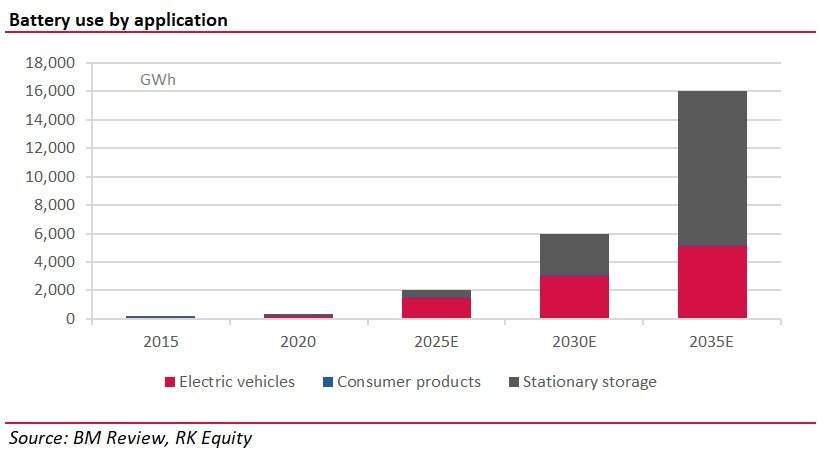
In fact renewable energy capacity additions are up 21% YTD May, according to Ember Energy’s Monthly Wind and Solar Capacity Data, and global utility-scale ESS installations are up 27% YTD June. In our model, we expect ESS to exceed EVs as a user of cells by 2031, based almost entirely on renewables-related demand. Hyperscaler demand is a nice positive, but not a key driver of global ESS demand, in my view.
3. How much the economics of lithium-ion batteries have changed
I don’t want to cast aspersions, but there are quite a lot of stale Lithium bears in the market! Many of these cite how non-viable the cost of batteries are for EVs and for storage and how the cost of renewables+storage is so much more than that for fossil fuels, etc.
While that may have been true once, it is no longer true now.
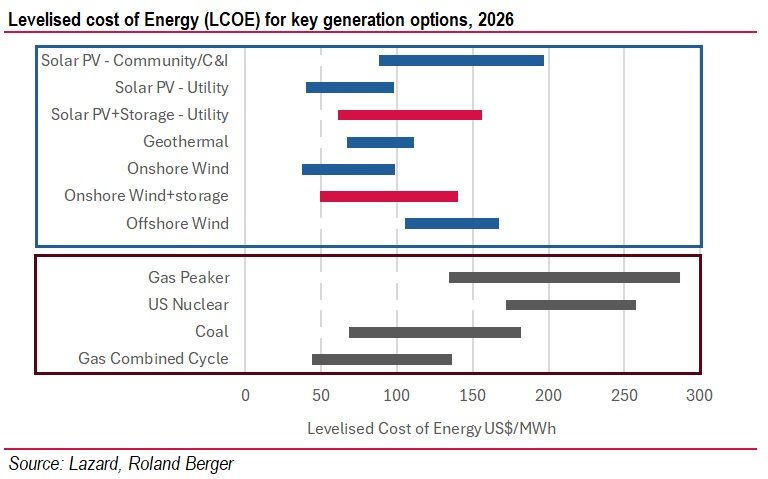
There are a number of reports out there that track the cost and economics of batteries. BNEF do a very good annual report on global battery prices, and Roland Berger/Lazard also have an excellent report on the Levelised Cost Of Energy (LCOE) which is more weighted towards the US. Both of these highlight how much the economics of lithium-ion batteries have changed in only a few short years.
Indeed the BNEF report highlights that the blended average cost of a lithium-ion battery back in 2025 fell to US$108/kWh (US$74/kWh at the cell level) and, indeed, Chinese pack prices had fallen to much lower than this. That’s down from an average pack cost of US$365/kWh in 2016. While it has risen a little in 2026, that rise is not by a sizable enough amount to render batteries uneconomic in ESS and EV applications, in my view.
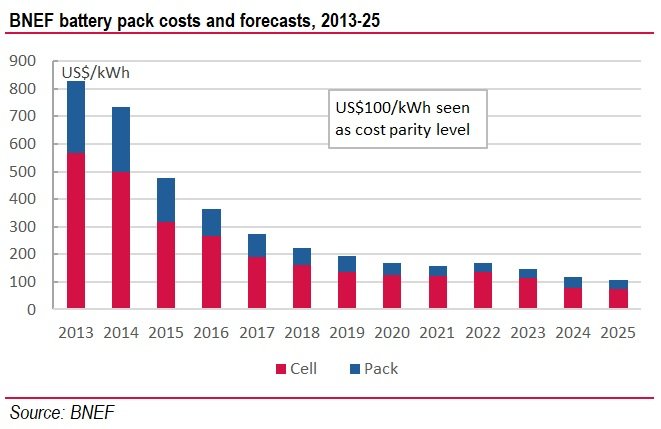
So the many stale bears out there that highlight that EVs are uneconomic without subsidies, or that renewables+storage are more expensive than fossil fuel sources are now incorrect due to the substantial change in economics seen in the industry.
This means that in many parts of the world, EVs have cost parity or are cheaper than ICEs not only to buy but to run as well, and renewables+storage are much cheaper to build and run than many fossil alternatives.
That has a big knock-on impact on demand, meaning that these industries can now function without subsidies over the long-term.
4. The market is underestimating the arithmetic of compounding demand
I’ve been working as a Commodities analyst for 25 years now. I’ve never covered a material where demand is growing, and is set to grow, for such a long period at such a high rate of growth as lithium.
And I think that the market underestimates how important that is.
When I started covering the lithium industry in 2017, the market size was 214Kt of LCE (Lithium Carbonate Equivalent). By 2020, that had reached 333Kt, by 2023, c.900Kt and in 2026 we’re forecasting 1.8Mt of LCE demand.
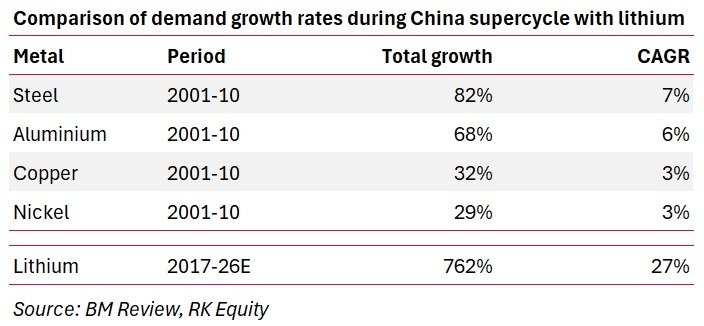
That’s a compound annual growth rate of 27% per year. And, on my model, lithium demand growth rates could continue to average 20% per annum over the next 10 years as well.
Just to give you some comparisons, during the period 2001-10 when the China supercycle was in full flight, the CAGR for global steel demand, one of the fastest-growing commodities, was 7%, only a fraction of the magnitude of growth we’ve seen and are likely to see for lithium.
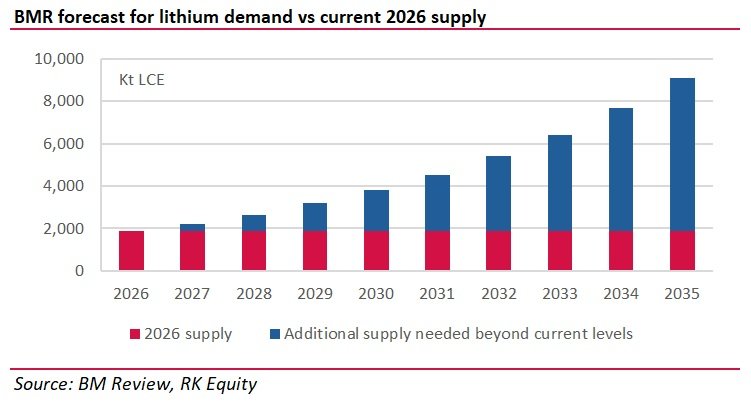
Think about what that demand growth means for the market. By 2035E the lithium market could exceed 9Mtpa of LCE. That’s nearly FIVE TIMES its size in 2026E.
How easy is it going to be to grow supply by that amount?
Bearing in mind that the current largest lithium mine in the world (Greenbushes) produced c.170Ktpa of LCE over the past 12 months and the biggest brine asset (SQM’s Atacama) produced 243Kt of LCE.
Brownfield expansion isn’t going to be enough to fill in this demand/supply gap. We’re going to need 30+ major new Greenfield projects with capacity in excess of 100Ktpa of LCE.
And for those to be built we’re going to need incentive prices to be in the region of US$25-30/kg for lithium chemicals.
I recently did an exercise for a client where I looked at where that additional supply could come from by 2035E. And – let me tell you – it was difficult to find it! I had to make substantial assumptions like:
- 50% of current DLE projects are built
- 50% of current sedimentary lithium projects are built
To get anywhere close to hitting those forecast demand rates.
So I know that lots of commentators from outside look at the lithium market and say – no way that it’s tighter than copper or uranium, which are resource constrained. But in my view – due to the huge demand pull – it is likely to be.
5. The market confuses geological abundance with producible supply
In his presentation to the Fastmarkets Global Lithium Battery and Critical Minerals Conference in June 2026, PLS CEO Dale Henderson said that “the future [of lithium] will be shaped not by the resources we discover, but by the supply we can reliably deliver”.
I think that that is a very, very important aspect of the industry that we must reflect on at the moment. He went on to further state that “The challenge is not identifying lithium resources. Plenty have been identified. The challenge is converting those resources into dependable supply.”
Lithium prices over the past 12 months have bounced back to around US$20-25/kg from very oversold levels. That’s pretty close to the incentive price for new production. But many lithium equities, particularly developers, are not factoring that into their valuations.
And that makes it very difficult for them to raise the capital needed to add the new supply which we are certain to need, in my view.
Over the past 12-18 months, the equity markets have practically dried up as a source of capital for most exploration and development stage lithium stocks. And that’s removed what has been a key source of capital for mining and related industries over the course of the past 20-30 years.
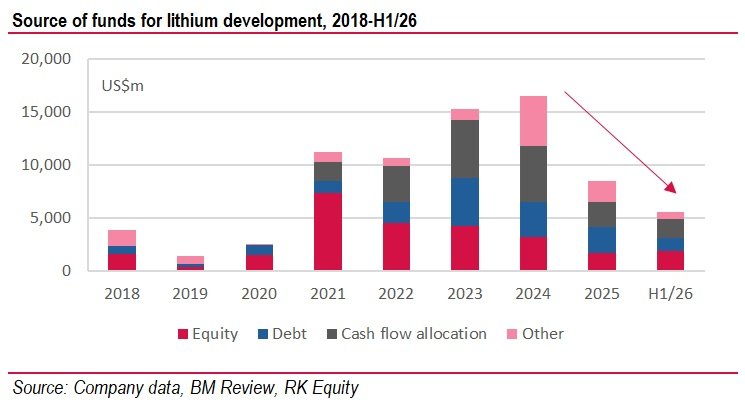
What that ends up meaning in actual terms is that, apart from the small number of development assets that are able to attract either government support or an outside investor with deep pockets, the rest of the industry despite having developable projects, is unable to develop them. At Battery Materials Review, I’ve tracked the amount of lithium resources added by the industry over the past few years. It’s significant. But the amount of lithium resources added by companies that have access to capital is much, much smaller. The chart below illustrates that only 56% of current ex-China lithium resources are controlled by companies that could potentially fund their development. And, of those, a large amount of projects are tied up by large companies which may very well only fund 40-50% of their resource inventory, in my view.
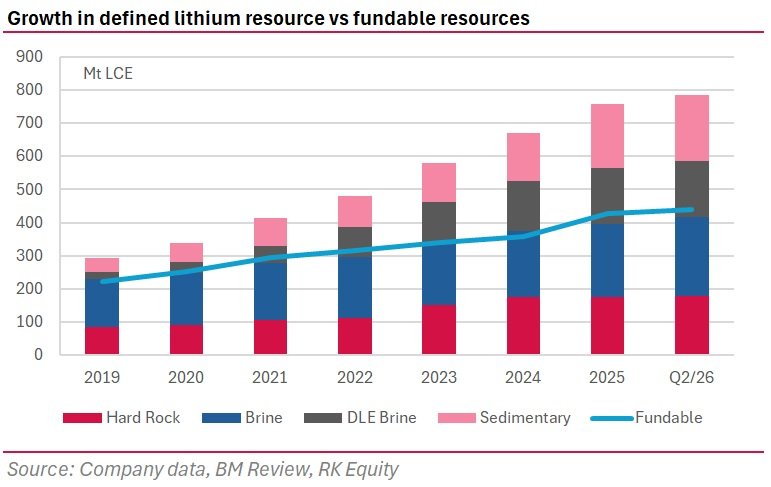
So, realistically, only 30-35% of current lithium resources are currently developable, maybe 280Mt.
And, to spell it out, that’s only 30 years of resources at current forecast demand growth rates. That’s not a lot.
And I believe that that’s what Dale Henderson was referring to in his presentation. The huge numbers of naysayers – mostly outsiders to the lithium industry, and generalists without detailed knowledge of it – are pushing valuations down for developers, making it practically impossible to fund the next stage of growth that is going to be so important for the industry.
Key takeaways
So, when we’re marking Mr & Mrs Market’s report card, it gets a big fail on these areas, which have a substantial impact on the viability of the lithium thematic:
- Sodium-ion is NOT a replacement technology. Those who insist it is are probably understating battery demand for lithium by a substantial amount.
- Renewables is a much bigger driver of battery demand than data centres. Even if hyperscaler investment is not as high as many commentators forecast, it’s not all over for ESS.
- The economics of EVs and ESS has changed in the last five years. Government subsidies are no longer needed for successful deployment of EVs and ESS, and assuming they are is a mistake.
- Underestimating the effect of compounding demand over a long period means that the market is underestimating the supply stress that the industry is under.
- Because share prices are depressed, the industry’s ability to finance new projects is restricted. There’s a difference between resources and investable resources that the market doesn’t seem to be understanding.
Factoring all these issues in, I strongly believe that the outlook for lithium is much stronger than many outside “commentators” suggest and those who are not invested in the sector should have a much closer look at it.