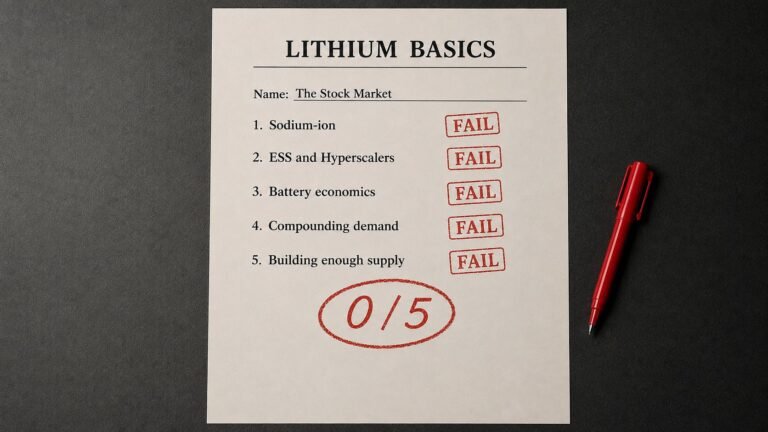


Copper analysts keep finding more supply. Lithium analysts keep finding more demand. What if investors are focused on the wrong side of both markets?
Copper is the market’s sweetheart. Lithium is its whipping boy. But would it surprise you to know that copper forecasters have repeatedly underestimated how much medium to long-term supply the industry would produce? Lithium forecasters have repeatedly underestimated how much lithium the world would consume. Today’s investment narratives arguably assume precisely the opposite: chronic copper scarcity and chronic lithium abundance.
Commodity forecasting is difficult.
I know. I’ve been doing it for over 25 years now.
But what’s important about commodity forecasting is not the errors that have been made; it’s how forecasters get things wrong – and whether those errors show a consistent pattern.
I recently went back through several years of supply and demand forecasts for copper and lithium. I wasn’t looking to score points against individual analysts. Forecasts are snapshots based on the information available at the time, and forecasting rapidly-changing commodity markets five or ten years into the future is inherently uncertain.
What I was focusing on was something else. Namely that the forecasting errors in copper and lithium have been strikingly different:
- In copper, analysts have repeatedly underestimated future supply
- In lithium, analysts have repeatedly underestimated future demand
That is particularly interesting because current investor sentiment towards the two commodities could hardly be more different.
Everybody loves copper
The investment case for copper is by now very familiar.
Electrification requires enormous quantities of copper. EVs, renewables, electricity grids and, increasingly, data centres all add to demand. Meanwhile, the supply side faces declining grades, ageing mines, increasing capital intensity, political risk and permitting timelines that can stretch well beyond a decade.
The conclusion seems obvious: the world needs substantially more copper, but the mining industry cannot build the mines quickly enough.
This narrative has become sufficiently accepted that structural copper deficits several years into the future are now almost conventional wisdom. We’ve all seen the charts of the emerging medium-term supply/demand gap in copper.
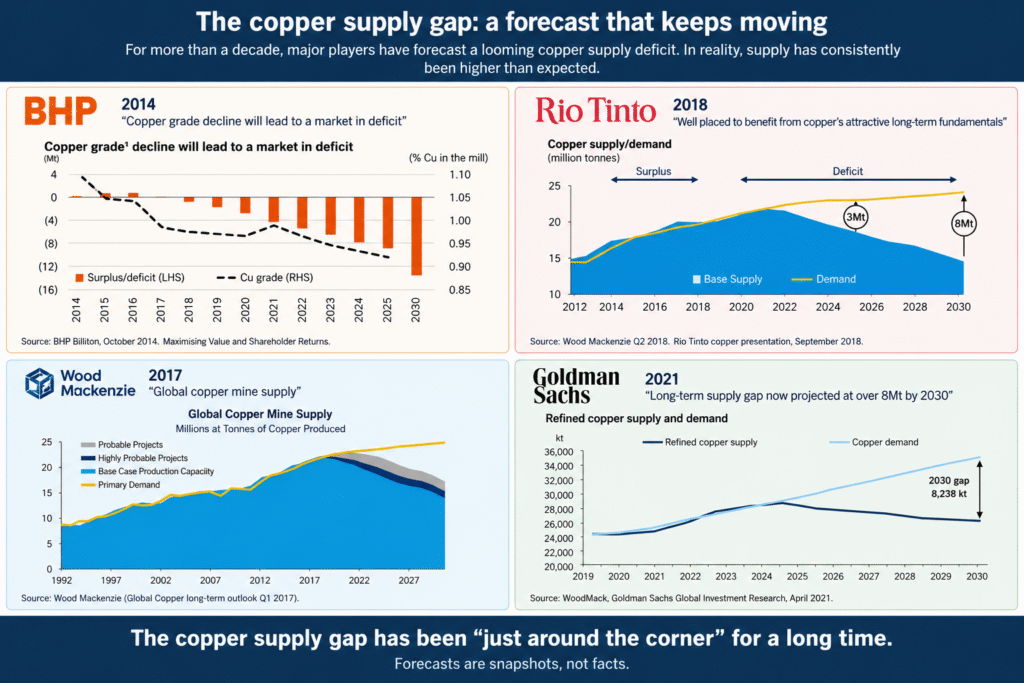
There is just one problem. Copper supply has consistently turned out to be greater than forecasters previously thought it would be. The charts above highlight that the major mining companies and consultants have been forecasting a major structural copper deficit for the best part of ten years, which has not really manifested.
I looked at successive forecasts produced by one Major global Investment Bank. Its forecast for global copper supply in 2030 has risen with remarkable consistency from 25.6Mt in its 2021 forecasts to 30.3Mt in 2026. In approximately five years, the same forecaster has found almost 5Mt of additional annual copper supply in 2030. That’s an increase of almost 20%.
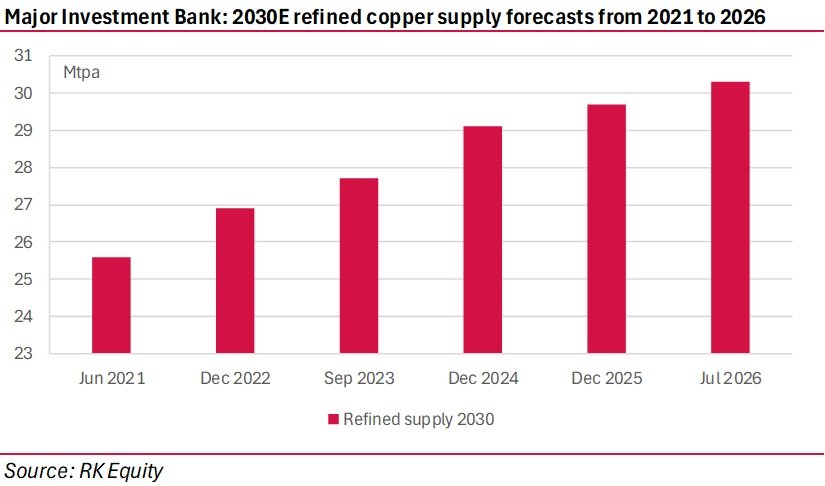
Copper demand expectations have risen too, but by nowhere near as much. The same forecaster’s 2030 demand estimates progressed from 28.6Mt in its 2021 reports to 31.0Mt in 2026, an increase of c.8%. Compared to c.20% for supply.
The important point here isn’t that copper demand has disappointed. It certainly hasn’t. But the projected copper deficit has narrowed because forecasters have repeatedly found supply that they hadn’t previously expected.
That does not necessarily make the copper bull case wrong. It may mean that the projected deficit is less a forecast of missing tonnes than an estimate of the higher price required to mobilise them.
Where does the extra copper come from?
I categorically do not disagree with copper bulls out there worried about copper supply. Copper projects genuinely are difficult to develop. Grades really are declining at most mature operations. Permitting really does take too long. New mines really can cost billions of dollars.
But there is a danger in extrapolating those individual observations into a forecast for an entire industry. Supply doesn’t only come from the handful of greenfield mega-projects that dominate investor presentations.
I think one of the big mistakes that the forecasting industry makes is extrapolating forward from existing reserve lives. I remember when I covered Antofagasta in the 2000s. Its Michilla mine was originally mooted for closure in 2009 based on reserve exhaustion. But copper prices were high, the operation was fully depreciated and it had a workforce. The Michilla mine was only finally closed in 2015.
Another area where the industry has historically also been wrong is in scrap or secondary supply. Generally this is underestimated by the industry, but in times of high prices more somehow becomes available. There’s an awful lot of half-built apartments in China at the moment that contain a substantial amount of copper that could become available in coming years, in my view.
A third area that the industry has been bad at forecasting is in regions dominated by China. Particularly the DRC, but also China itself. Both regions have substantial copper resources. Supply from both has been structurally underestimated by Western forecasters.
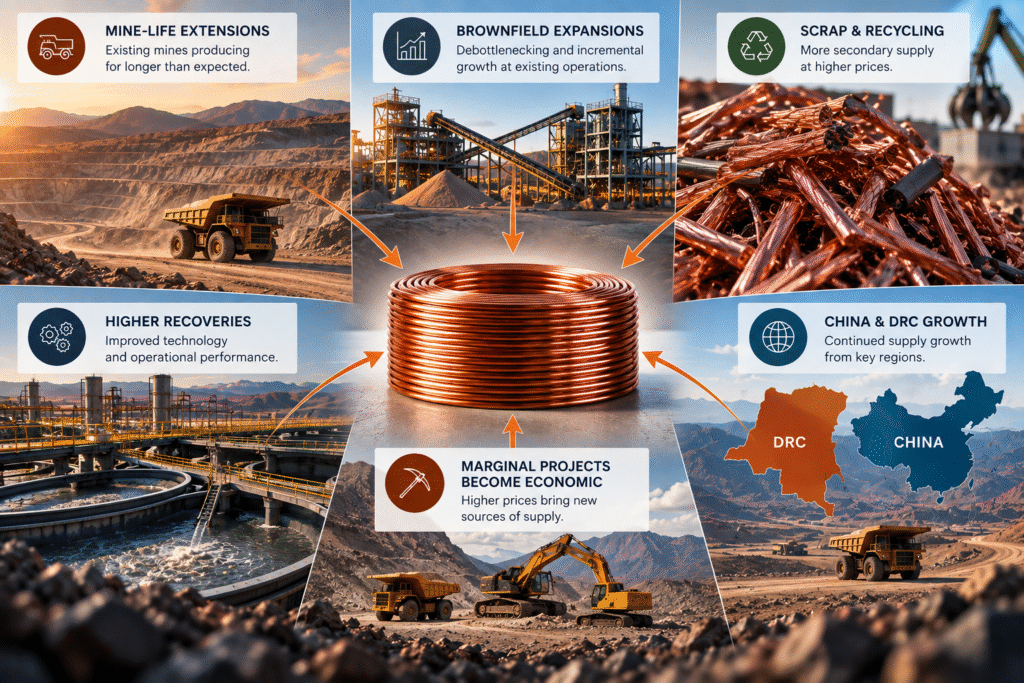
There are other factors at work as well. Recoveries improve. Brownfield projects are developed. Previously marginal projects become economic. Technology improves. And hundreds of relatively small supply responses collectively become significant.
Paul Gait, Head of Strategy at Anglo American, made this distinction when we interviewed him two years ago. Large greenfield projects often disappoint, but rising prices draw out brownfield expansions, existing infrastructure, tailings, scrap and improved recovery. The industry can therefore produce more copper than project-by-project forecasts suggest, although it may require a higher price.
None of this means that the copper market cannot become tight.
It does, however, suggest that investors should treat projections of enormous deficits five or ten years from now with appropriate caution.
Because, while long-run copper demand has been somewhat underestimated by many forecasters as well, long-run copper supply has been structurally underestimated.
Lithium has the opposite problem
Lithium offers an intriguing mirror image.
In lithium, most investors don’t worry that there won’t be enough supply. They worry that there will be far too much of it.
And that view isn’t unreasonable.
Lithium supply has consistently surprised to the upside over the past decade. Australian hard-rock production expanded rapidly. Chinese lepidolite emerged. African spodumene became significant. South American brine capacity grew.
The lithium industry’s supply response has been extraordinary.
But something else extraordinary has happened at the same time. Lithium demand has repeatedly grown faster than analysts expected. And not by a small amount either. In 2021, Battery Materials Review’s (my) forecast for lithium demand in 2030 was 2.6Mt of LCE. Now that forecast is 3.8Mt. That’s a 44% difference.
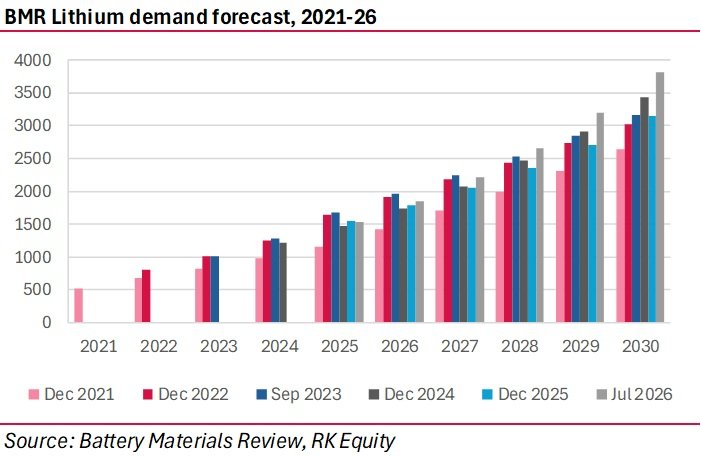
You might conclude from that that I’m lousy at forecasting! But actually I’m nowhere near the worst… In 2021, the Major Investment Bank that I referred to earlier originally forecast 1.7Mt of demand in 2030. Its latest forecast is for 2.7Mt. That’s a 54% change, and I would suggest that its current forecast is too bearish. More importantly, its medium-term demand forecasts have consistently underestimated the growth of the lithium market.
Yesterday’s bullish forecasters became today’s reality
Indeed, perhaps the most interesting comparison in lithium isn’t for 2030 at all. It’s forecasts for years that have subsequently arrived.
Back in 2021, BMR estimated lithium demand in 2025 at approximately 1.16Mt LCE. That looked really aggressive at the time. By 2022, I had increased my estimate to c.1.65Mt and 1.68Mt in 2023. By my numbers, the eventual market size in 2025 was c.1.7Mt.
In other words, one of the industry’s more bullish forecasters still substantially underestimated the size of the market when looking four years ahead.
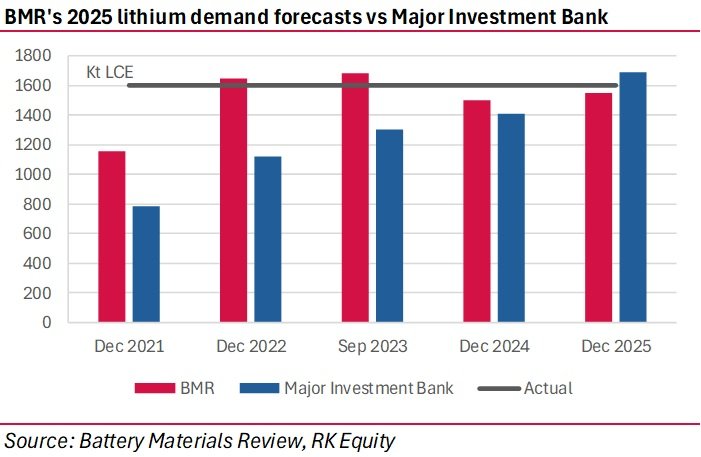
The forecasting record of the Major Investment Bank I cited earlier is even more striking.
In 2021, it expected lithium demand in 2025 of just 783kt LCE. Its successive forecasts subsequently moved dramatically higher as the year approached.
Lithium supply forecasts have also been revised substantially higher – in some periods by even more than demand.
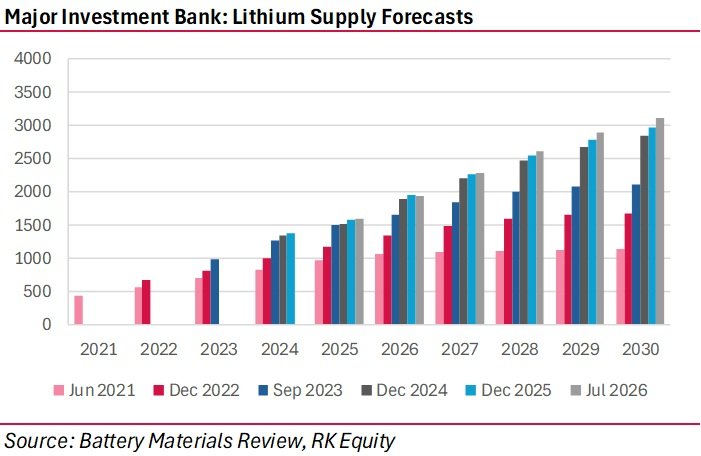
That’s important and shouldn’t be ignored. But it doesn’t change the central observation: the lithium market has repeatedly become much larger than forecasters thought it would.
Two commodities, two forecasting errors
This leaves us with an interesting paradox:
- Investors looking at copper see enormous projected future deficits and conclude that supply simply cannot respond quickly enough.
- Investors looking at lithium see enormous projected supply growth and conclude that demand cannot possibly absorb it.
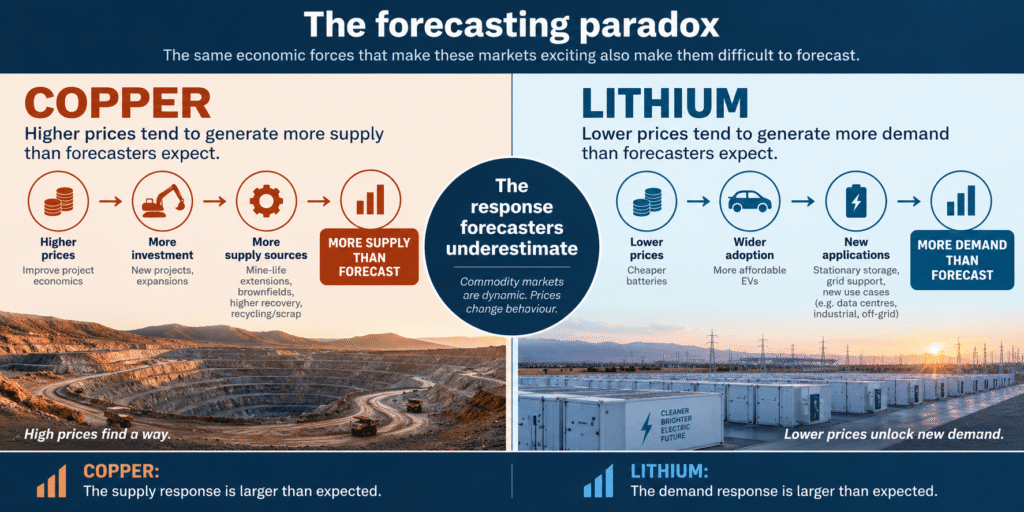
There is an important distinction between the two markets. Lithium has consistently delivered more supply than forecasters expected. But lithium resources have proved abundant and the capital required to add a meaningful increment of new supply is substantially lower than for copper. The lithium industry’s ability to respond rapidly to higher prices should therefore not be surprising. What is more surprising – and less appreciated – is that demand has repeatedly grown quickly enough to absorb most if not all of that additional supply.
Yet the forecasting history tells us to be cautious about both assumptions around copper supply deficits and lithium surpluses. In copper, analysts have repeatedly underestimated the ability of the supply side to respond. In lithium, analysts have repeatedly underestimated the ability of the demand side to grow.
Neither observation tells us what copper or lithium prices will do next year. Nor does it prove that today’s forecasts are wrong. But it should influence how much confidence investors place in long-term projections.
Forecasts are snapshots, not facts
The further into the future a commodity forecast goes, the more it inevitably embeds assumptions about things we cannot yet see.
Nobody forecasting lithium demand five years ago knew precisely how quickly LFP batteries would penetrate the global EV market, how rapidly Chinese EV sales would grow, or how dramatically stationary energy storage would expand.
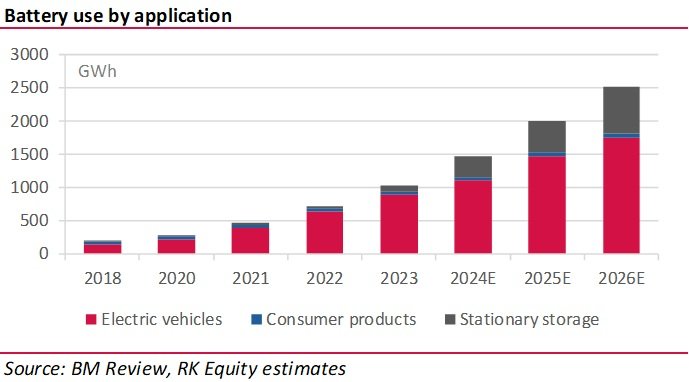
Similarly, nobody forecasting copper supply knows exactly which projects will be approved, which existing mines will expand, how scrap supply will respond or what technological improvements might emerge.
Yet a supply/demand forecasting spreadsheet inevitably converts all those uncertainties into precise numbers.
A projected 2030 deficit of 700kt looks authoritative. A projected 2030 surplus of 300kt looks equally authoritative.
Neither is.
What matters is understanding where the forecasting model has historically been most vulnerable.
- For copper, the evidence suggests that vulnerability has been in medium to longer term supply
- For lithium, it has been medium to longer term demand
What the market may be missing
There is plenty to like about copper: Demand is growing, new mines are difficult to build and electrification will require enormous investment in copper production. But much of that optimism is already embedded in the investment narrative. Investors are explicitly worried about copper scarcity.
Lithium is different.
The market has spent the past several years focused overwhelmingly on supply: new mines, African production, Chinese lepidolite, brine expansions and the seemingly endless pipeline of projects waiting for higher prices.
Those concerns are all legitimate.
What gets considerably less attention is the other side of the equation. Lithium demand has already confounded medium- and long-term forecasts repeatedly. And, as energy storage joins electric vehicles as a second major engine of lithium consumption, there is no obvious reason to assume that that forecasting challenge has disappeared.
Perhaps the biggest lesson from the past five years isn’t that commodity analysts are too bearish or too bullish, it’s that industries adapt.
High copper prices incentivise the world to find more copper. Mines expand, mine lives are extended, scrap emerges and marginal tonnes become economic.
Lithium has its own feedback mechanism, but it operates on the other side of the ledger. Falling lithium and battery prices make batteries economic in applications that previously weren’t viable. EVs get cheaper, storage duration increases and entirely new sources of demand emerge.
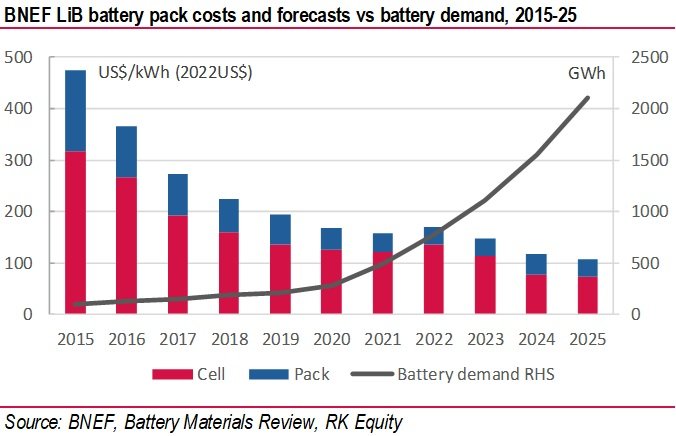
Investors seem very comfortable extrapolating the supply response when thinking about lithium, but considerably less comfortable extrapolating lithium demand. In copper, arguably the opposite is true.
None of this means that I’m bearish on copper. I’m not. Copper may well require substantially higher prices to incentivise the supply the world will need. But huge long-term deficit forecasts arguably make the copper investment case look more certain than history suggests.
Lithium currently presents the opposite risk. New supply is easier and less capital-intensive to develop, but investors may be placing too much weight on that supply response and too little on the demand response that lower battery prices themselves create.
That is the paradox. Copper investors may be overestimating the certainty of scarcity, while lithium investors may be underestimating the ability of demand to grow into abundance.