I see a lot of rubbish written about lithium inventories and, given that there’s a very substantial bifurcation of views about what’s going on in the lithium market at the moment, and that much of that bifurcation is driven by perception of current inventories in the lithium supply chain, I thought I should address some of the points.
Chemicals inventories are LOW and FALLING
I’ve been a commodity analyst for over twenty-five years now. One of the relationships that I was taught early on in my career as a paper analyst, then a metals analyst and then a chemicals analyst, was the relationship between prices and inventories. It’s a basic rule of economics.
When inventories are low it means there’s a deficit of material in the market and prices tend to be high, and vice versa.
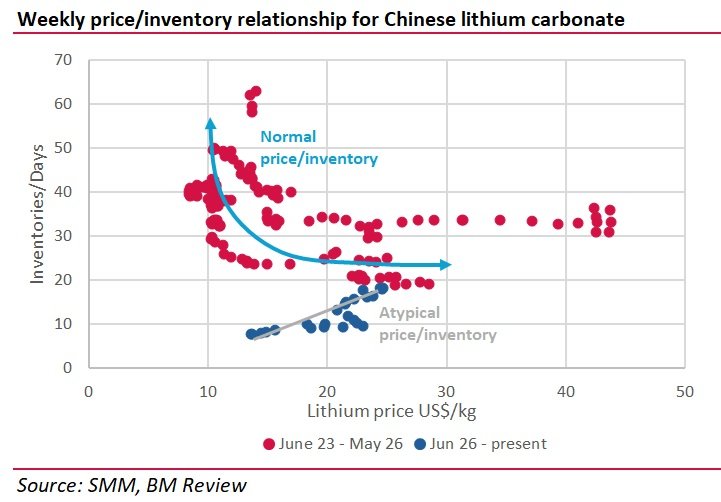
But, as I’ve covered extensively in recent weeks, over the past few months, that relationship has broken down in lithium chemicals. Despite inventories being close to their lowest-ever levels, prices have been falling as well. I normally plot the weekly price/inventory chart that I’ve published above on social media when I refer to this, but I thought it would be worthwhile showing the longer monthly relationship as well for this article.
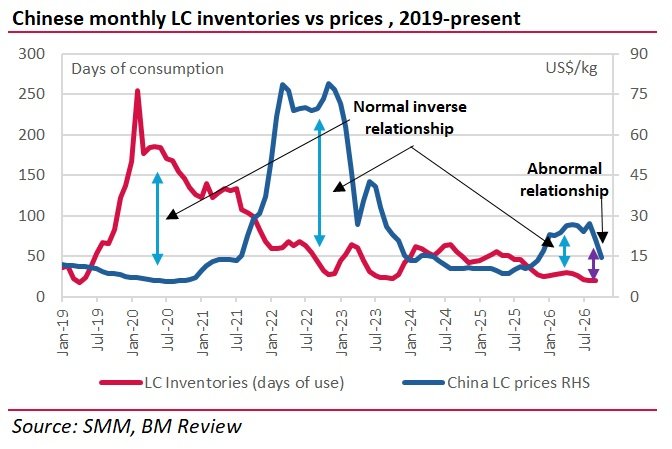
You can see that, up to recently, the inverse relationship between prices and inventories that one would expect to exist in lithium has existed. It’s only in the last two months that it had broken down.
Many commodities analysts are as confused over this as I am, but a lot of people in the industry have started citing downstream inventories as the reason for the weakness.
Rate of growth impacts how inventories are perceived
A build in downstream inventories was what caught most commentators out in the last boom/bust cycle in lithium in 2023 and I’ve been keeping an eye on downstream inventories and their trends ever since.
A lot of people look at the pure numbers for downstream inventories and panic, but I’m not panicking, even though I’ve been tracking that inventory build for nearly two years now. And the reason I’m not panicking is that there’s a lot more nuance than there seems to be if you just look on the surface.
First up, let’s discuss absolute levels vs days of consumption.
If one just looks at absolute inventory levels for the lithium industry they’re going to be depressed – but also wrong. When I’m looking at an industry like steel or copper, where demand may be increasing at 2-3% per annum, then comparing absolute levels over time can be relevant.
But in lithium, the market has been growing at 30+% y/y for the past seven years. So comparing absolute battery or EV or ESS inventory levels now with the sort of level they were at even last year is daft.
Just think about this example. In 2024, China’s EV battery production was 878GWh. In 2025 it was 1246GWh. So 100GWh of inventory in 2024 would have been 42 days of supply. 140GWh of inventory in 2025 would have been 41 days of supply.
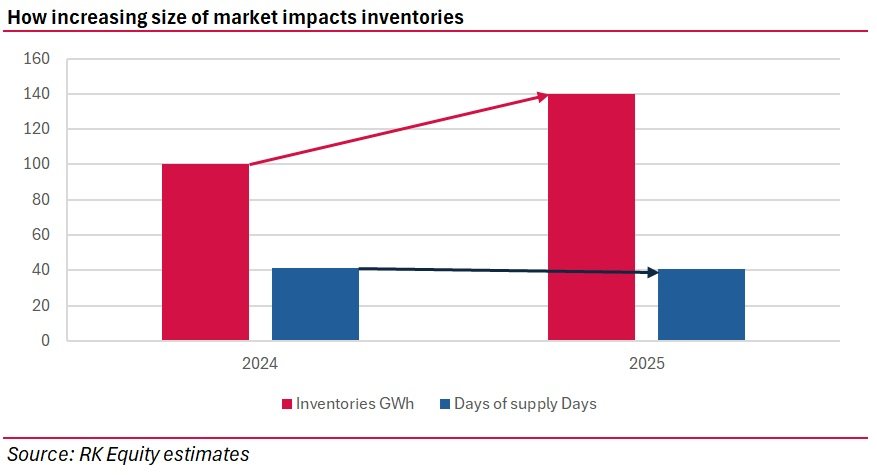
In absolute terms, it looks like a 40% increase, but when you back out the rate of growth of the industry, it’s actually a shrinkage.
That’s why comparing inventory levels in absolute terms is a mug’s game in this industry.
The nature of the Downstream is changing
I think this is the most important factor in the industry that people are not considering.
Let’s start with EVs.
It’s fairly easy to calculate what China’s EV inventories are. I just take China’s apparent consumption of EVs (which can be calculated on a monthly basis from CAAM numbers) and subtract its EV sales from that. That gives me an inventory number and ‘lo and behold, that number has increased in both absolute and days of supply terms over the past 18 months.
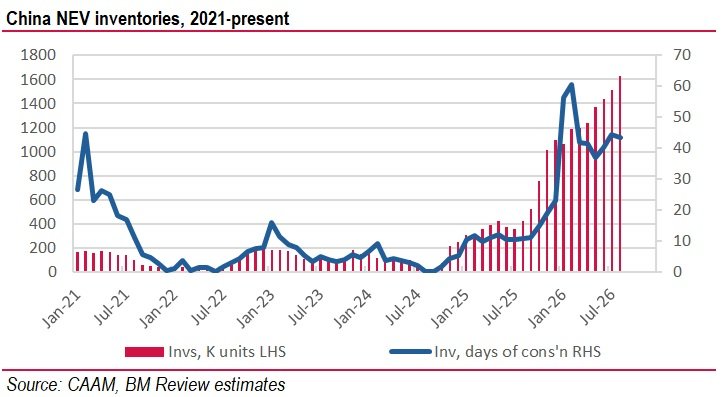
Well, surely that’s a car crash?! [Sorry, couldn’t resist!]
But actually I don’t think it is, because you have to understand the changing face of China’s EV industry.
China’s EV exports have also increased very substantially. They’re now something like 30% of China’s EV output, up from 5-10% in the early-2020s.
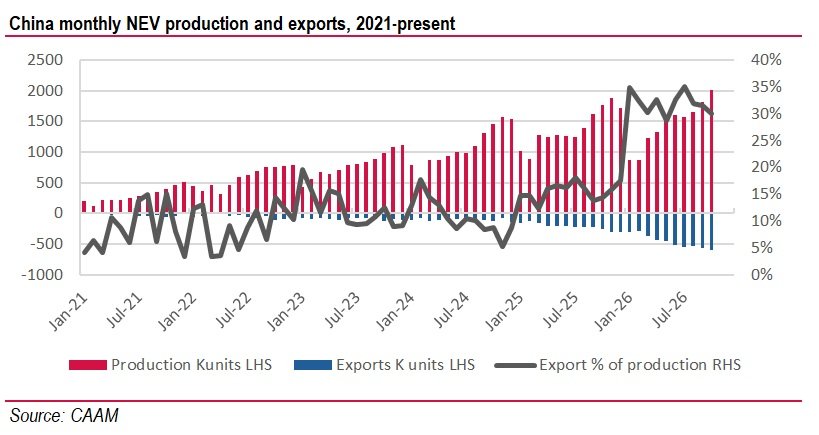
Why is that relevant? Well, consider the stages of the supply chain. In China’s old EV industry, EVs were produced in one province in China and – for the most part – consumed in the same province in China. There would be inventories at the car factory and then the cars would be distributed and then sold.
But exporting cars is different:
- Sure, you’ve still got the build up at the factory.
- But now you have to ship them to a port which could take several days.
- And store them at the port til a ship becomes available to ship them, which could be weeks.
And only when they’re actually shipped do they show up as exports and come off the apparent consumption number.
This results in the normalised level of inventories being higher than if China was just making cars for its domestic market.
Understanding the ESS supply chain
And that situation is even more pronounced in the ESS supply chain than it is in the EV one. And that is something that many commentators are simply not understanding.
In RK Equity’s latest quarterly presentation, I did a deep dive into the ESS supply chain for our clients. I produced the graphic below to illustrate the length of the supply chain. It highlights the substantially longer supply chain associated with shipping ESS cells around the world.
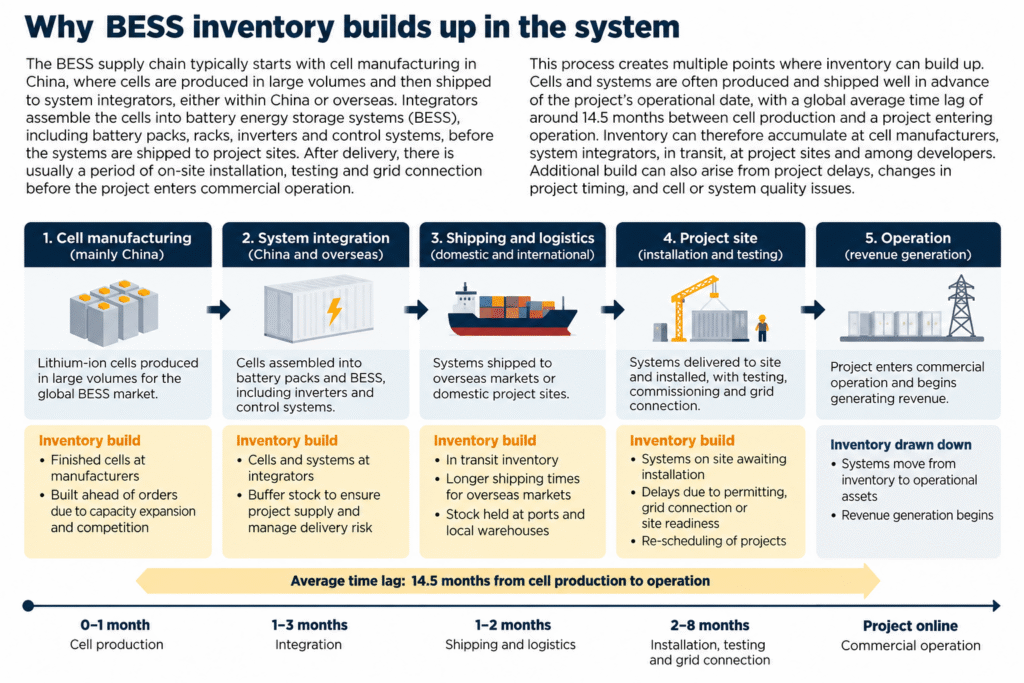
In a genuinely global ESS market where cell manufacturing takes place in China and all other levels of the supply chain may be in China or elsewhere, it’s extremely viable that the supply chain could exceed 15 months, particularly if there are delays to BESS installations in some regions.
This extended supply chain is not well understood by many industry consultants and analysts. Hence the very real concern about the current build in BESS cell/battery inventories.
But – for me – it’s not so bad. We currently have c.20 months of ESS inventories vs the c.15 months which I believe is normal.
Another issue for me that’s very important is this. Yes, ESS inventories are a little higher than they probably should be. But ESS installations are still growing at 20+% y/y. That’s installations, by the way, not shipments. So actual real ESS demand is growing at 20+% y/y. In that environment it’s difficult to become too worried about inventories.
If the rate of growth starts to fall, sure – then inventories might be a problem. But absent that fall in the rate of demand growth, I just can’t be too worried about inventories.
ESS inventories and obsolete cells
There’s another issue associated with the “build” in ESS inventories that people aren’t talking about.
And it’s potentially a very important one.
It’s the issue of obsolete cells. Many people aren’t aware, but the technology of ESS cells has totally changed over the past 2-3 years.
- In 2022-23, the standard ESS cell format was the 100Ah cell.
- By 2023-24, the standard cell had become the 280Ah format.
- In 2025, 314Ah cells were increasingly displacing 280Ah ones.
- Now 500Ah and larger cells are starting to enter commercial production.
What happens to the increasingly large amount of obsolete cells that may have been manufactured over the past 3-4 years but haven’t been used because the industry has developed too fast?
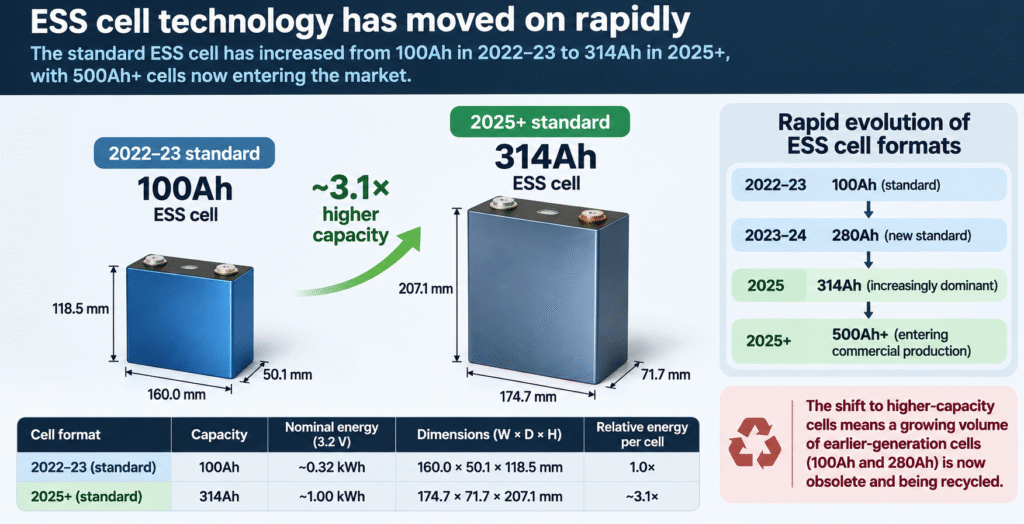
Well, the bulk of them go to recycling. And, while that’s accounted for in tracking the amount of lithium carbonate equivalent produced from recycling, it’s NOT accounted for in reduction of ESS cell inventories. Because – at the moment – nobody is tracking how many obsolete ESS cells are being recycled.
And, by the way, these numbers are starting to become big. If we assumed that only 10% of the output of ESS cells made in 2025 was obsolete, that would account for over 7% of currently-calculated ESS inventories. If we included cells from 2024 and 2023, that would take the calculated global ESS inventories back to 15 months of demand, about where we would expect them to be given the development of the industry.
So, it’s not something that people are really tracking, but I think it’s an important consideration.
The market is getting lithium inventories wrong
So my takeaway is that the market is panicking much more about the build in downstream battery value chain inventories than perhaps it should be.
And it is not paying enough attention to the draw in upstream inventories as it should either.
At under 19 days of supply of lithium chemicals inventories (per SMM’s restated series), we’ll have a reckoning soon. And then one part of the market will flinch. I know which one I think it’ll be. Let’s hope I’m right!