
Read the trade press or listen to world leaders speak and there is one segment of the Mining industry that comes up again and again. Rare Earth Elements or REEs.
In only a short space of time these previously under-appreciated materials have been thrust to the forefront of the conversation about security of supply and strategic materials.
Why? Because this suite of metals which are generally found together in nature boast specific properties that make them important for high tech applications. Whether that is rare earth magnets (Nd, Pr, Dy, Tb) or defence applications (Nd, Pr, Dy, Tb, Sm, Eu, Gd, Lu, Y), both have become absolutely vital for the development of strategic industries.
And, after many years of doing really not very much about that, governments have finally been propelled into action over the past two to three years.
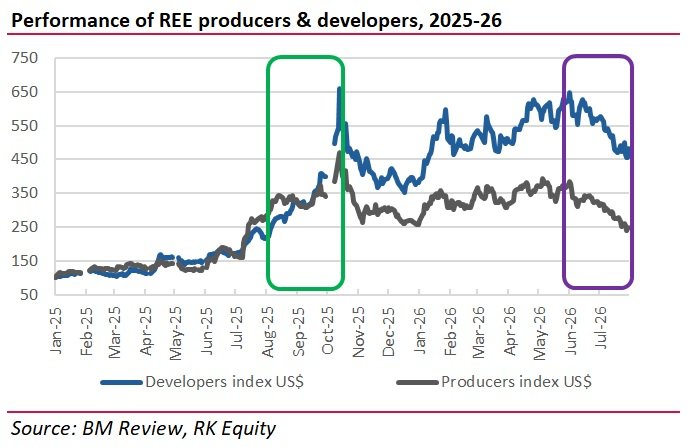
And that’s coincided with a period of very strong performance by REE producer and developer stocks globally.
But all of that has started to reverse over the past three months.
And what’s even more interesting than that was that the reversal happened despite considerable strength in REE prices.
So what’s going on and why did REE stocks suddenly de-rate?
When REE stocks were just Mining stocks
I’ve had a lifelong interest in the Rare Earth Elements. I first became interested in them when I was at university in the mid-1990s. The usage breakdown and economic drivers of the REE suite were very different then to what they are now, and for me that is one of the very interesting points about this suite of elements – that they have been able to re-invent themselves repeatedly over time.
I tracked Lynas Corp’s development and its first production at Mt Weld in the 2000s. I kept an eye on the travails at the Mountain Pass mine through its re-start and subsequent bankruptcy and its return to the market in 2020. And, since the 2010s, I’ve regularly invested in the REE sector and REE development projects.
And one of the things I’ve noticed in the past few years is that the behaviour of the stocks has changed substantially.
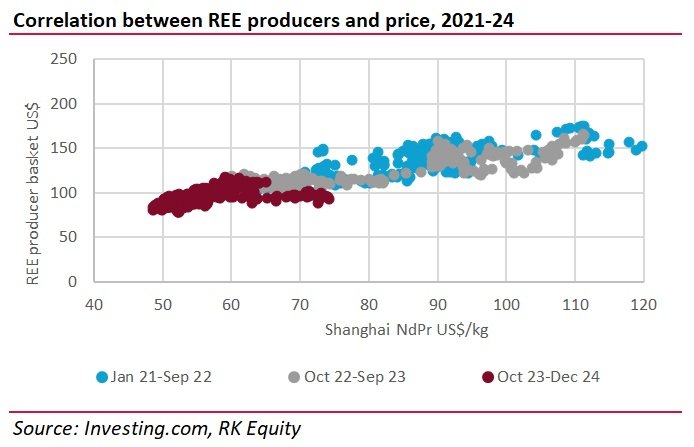
In the early part of this decade (and indeed the back end of the previous one) there was a pretty tight relationship between the Shanghai NdPr price (the global benchmark price for Neodymium and Praseodymium, which can make up c.80-85% of the economics of most REE mines) and equity performance. In fact, in the chart below, I’ve plotted the relationship between Shanghai NdPr prices on a daily basis and MP Materials’ and Lynas Corp’s stock prices in a basket.
Rare Earths were already seen as strategically important during this period. Japan had been supporting alternative supply chains since 2011, including through its relationship with Lynas, and Europe and the US had both identified rare earths as critical to industrial security.
For years, strategic importance and commodity fundamentals had coexisted. Then, in 2025, something changed.
2025: The year the rules changed
In 2025 the relationship that had previously existed between NdPr price and stock performance changed. And it changed substantially.
For starters, under the Trump Presidency in the US, REEs were getting a lot of mentions and a lot of column inches.
And then something BIG happened. The US-MP Materials deal in July 2025.
The landmark Public-Private partnership deal involved a 10-year guaranteed price floor for NdPr prices, which was nearly double the historical level of Chinese NdPr prices. It catapulted REE onto the front pages and, for the first time, gave investors a tangible indication of the prices governments might be prepared to support to secure alternative supply chains.
REE stocks re-rated big time.
That wasn’t the end though for 2025. The next Act was China’s decision to expand export controls on some REEs, which was announced in October. For a short period of time, until the US and China came to an agreement that eased the imminent threat of shortages, many Western manufacturers were genuinely concerned as to where the next kilogram of REE was going to come from.
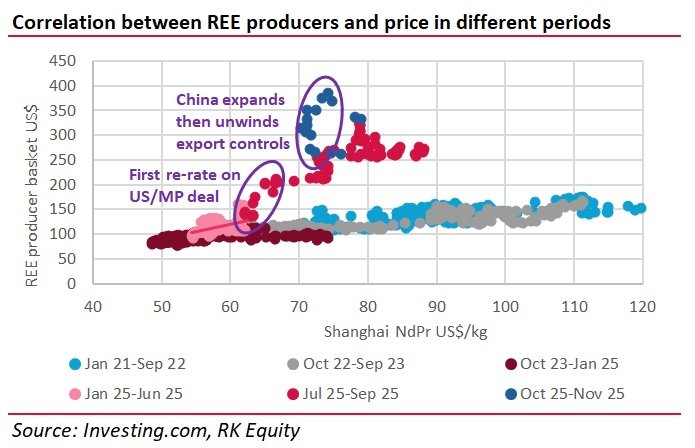
The above chart shows what happened in both of those instances. The REE equities rose, even though there was minimal change in the REE price. But the big question then was how much of that additional value was real?
The great unwinding
At the end of 2025, most people in the mining industry expected more of the same from the REE sector in 2026. And, for a time, that’s what they got. For a time the relationship with the NdPr price reasserted itself, but at a higher level. And I think that most investors – and REE industry participants – would have been happy with that.
Particularly as Chinese NdPr prices started to go on a bit of a tear in the latter part of the northern hemisphere summer.
But the problem was that equities didn’t go with them. In fact, equities started to correct massively. And the equity/price relationship seemed to reverse. Here was a situation where prices were rising but equities were falling. That’s pretty atypical in this market.
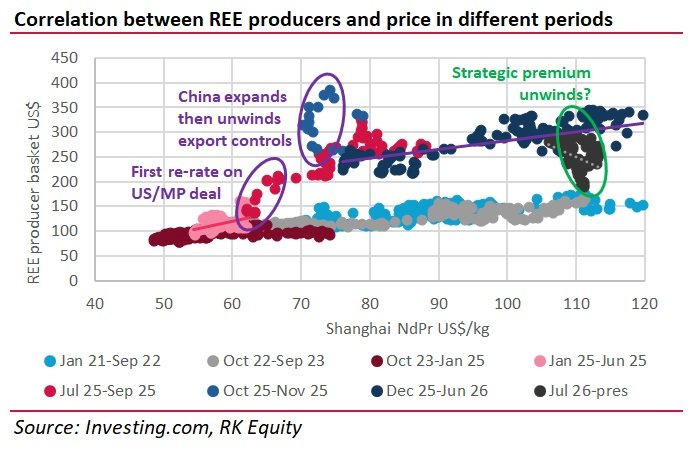
What’s particularly interesting is that the correction wasn’t simply a reaction to falling commodity prices. At NdPr prices of around US$110/kg, the basket of producer shares was trading at roughly US$300–350 earlier in 2026. More recently, at similar NdPr prices, it has been trading closer to US$220–280.
In other words, investors were prepared to pay substantially less for essentially the same commodity exposure.
So what’s happening?
Well, I guess there are two possible interpretations:
- The correction is justified. The earlier re-rating incorporated expectations for the REE market that were too optimistic.
- The correction is creating an opportunity. The market may be throwing the baby out with the bathwater; selling off the critical materials thematic without necessarily pausing to identify which segments deserve their premium and which don’t.
Is this an opportunity or a value trap?
I’m going to come down with the opinion that I think it’s an opportunity. But I’m going to caveat that statement.
The problem is that the market has a tendency to treat rare earth stocks and projects as though they’re all much the same, when in reality there are enormous differences between them.
There’s been a huge increase in the REE development projects available to invest in over the past 12-18 months. It now seems that everyone and his dog has a “world-class” REE project on their books.
For me, REE is one of the worst-understood spaces in global mining. It’s also one of the worst-researched. I noted before that NdPr represents c.80% of the economics of most REE projects. Certain heavy REEs are also important, but NdPr is absolutely key to the economics of projects. Not TREO (Total Rare Earth Oxide) or even other elements – NdPr.
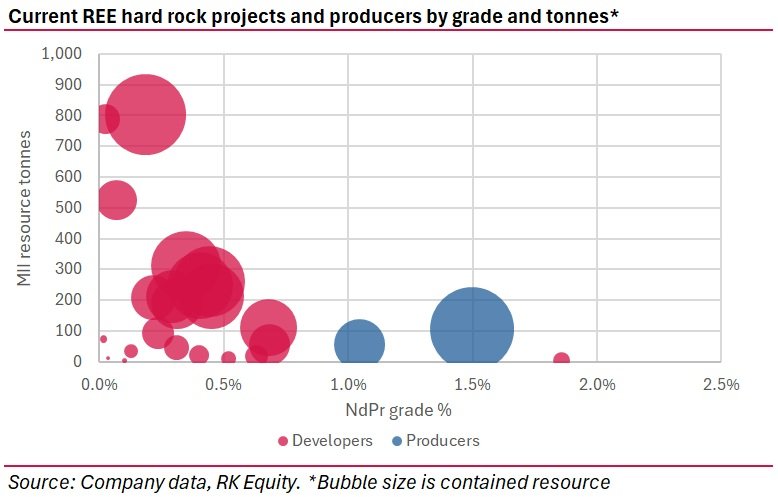
In the chart above, the blue bubbles represent producing mines and the red bubbles development projects. The further right a bubble sits, the higher its NdPr grade.
There is a very substantial difference between the grades of the mines that are in production and many development projects. While in-situ grade is not the only factor that determines how viable a project will be, it’s a key factor.
Of course, the type of host mineral is important as well. Ion adsorption clay projects (not included in the chart above) are a key segment of the REE space and can have significant processing cost advantages over some igneous-hosted REE projects. But even within these, we see a substantial range of grades.
It’s always a surprise to me how investors will invest in lower grade projects and I assume that that can only be because of the substantial education gap within the space.
So, I do believe that the sell off in the REE space is an opportunity. But not for the whole sector. It’s an opportunity to invest in producers and the – perhaps – ten percent of development projects that have the grades, processing characteristics and economics to actually become profitable mines.
The market may have been too enthusiastic about rare earth companies in 2025. But that doesn’t mean it’s right to sell them all indiscriminately now.