
Copper has long been known as Dr Copper for its ability to diagnose the health of the global economy. Recently, though, the metal has been attracting attention for very different reasons, surging to record highs and becoming one of the defining commodity stories of the past two years. But beneath the headline price move, something unusual is happening. And it may be telling us something important about where copper goes from here.
Something strange is happening in Copper
For most of my career as a materials analyst, there’s been one relationship that everyone could rely on; the inverse relationship between inventories and prices.
As inventories rise, prices fall and as inventories fall, prices rise.
It isn’t complicated. Inventories are the buffer between the producer and the consumer. When that buffer is being depleted, the market is tight and prices need to rise and vice versa.
But that relationship has broken down in copper over the past two years. Copper prices have been rising. And so have inventories.
That’s pretty unusual. And whenever a commodity stops behaving the way commodities normally behave, you have to ask why.
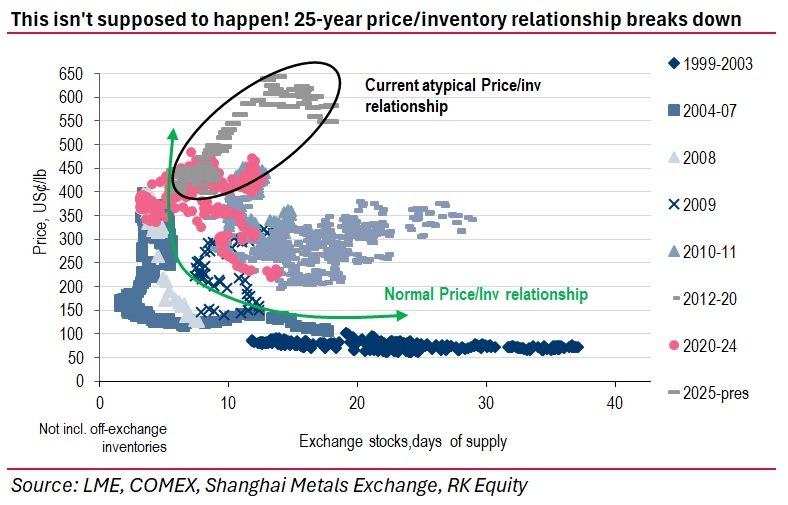
There’s an important qualification here. Much of the inventory build has occurred on COMEX as tariff expectations and the US premium have pulled copper into American warehouses. But this isn’t simply a case of copper moving from one exchange to another. Over the past 18 months, COMEX inventories have risen by c.610Kt while LME and Shanghai inventories have only fallen by c.27Kt and c.28Kt respectively. Combined exchange inventories have therefore increased by c.555Kt.
So the tariff trade helps to explain where the copper has gone, but it doesn’t explain why there’s substantially more copper sitting in exchange warehouses.
Why the market doesn’t care
Whenever I flag this issue, most commentators then reply “well the reason we’re building inventories is because of the huge forecast supply/demand deficit”. They contend that we’re going to need that inventory of copper we’re building over the medium-term when analysts are forecasting a massive supply/demand imbalance. We’ve all seen the charts like the one below.
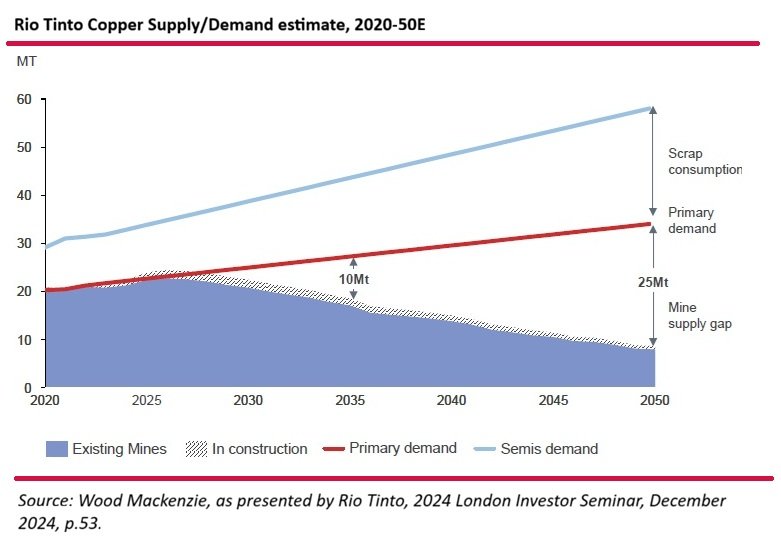
And, if you believe this chart, then who cares about another few hundred thousand tonnes sitting in warehouses today? We’re apparently going to need all the copper we can get.
There’s just one problem: we’ve all seen this movie before
I wrote in my last blog (Copper, Lithium and the Forecasting Paradox; 14 September 2026) about this issue. The chart above has been published by many mining companies to justify the strength in copper.
It’s really compelling.
If you believe it.
The problem is that similar charts have been published over the past nearly 15 years. And the structural deficit is yet to emerge.
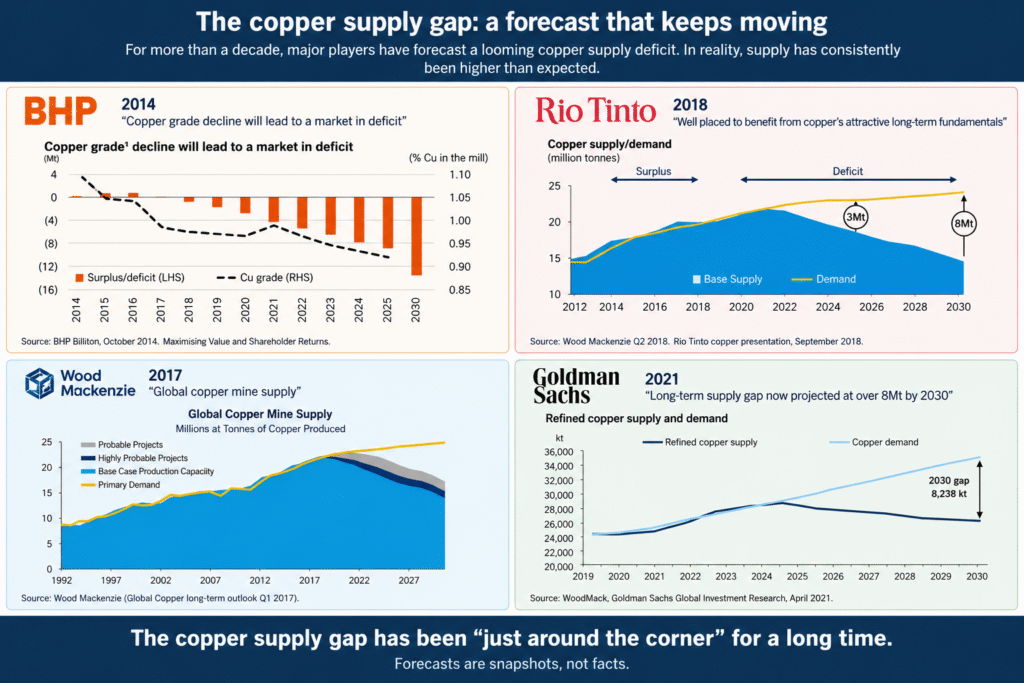
If we believed what BHP published in 2014 then by now there would be an 8-10Mt structural deficit in copper, RIO in 2018 forecast a 3Mt gap and GS in 2021, a 2-3Mt gap. Needless to say that that gap has not manifested.
I’ll note that in 2021, GS was forecasting an 8Mt supply/demand gap for copper in 2030E while RIO (in its 2024 presentation) is now forecasting that gap to have fallen to only a couple of million tonnes.
And what are analysts getting wrong? Well, it’s not demand.
Many analysts are getting supply forecasts completely wrong.
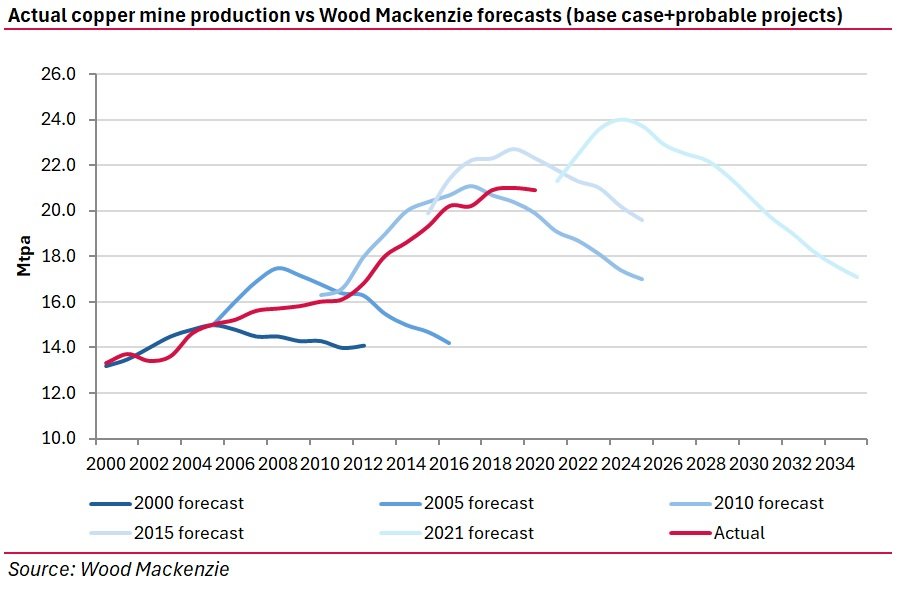
And it comes back to the point that I made in my previous blog. Extrapolating supply forward 10-15 years from reserve lives doesn’t work, because reserve lives can be extended, particularly in a high copper price environment. As the chart above highlights.
And – let’s face it – the market hasn’t been that great at forecasting near-term supply either! It tends to overestimate near-term supply and underestimate long-term supply. That’s not a great situation for investors!
By the way. None of this means that I’m bearish on copper.
It just means that I think we’re using the wrong framework to explain why copper prices need to be high.
Forget the forecast “deficit”. Look at the cost of producing the next tonne
For me, this gets to the crux of the matter. It’s not about a deficit which may or may not arrive. It’s about the difficulty of finding copper reserves and putting them into production.
One of the key issues for me in the copper industry at the moment is the decline in major discoveries. In the 2000s when this first started to emerge we used to talk about the low hanging fruit being picked. But the fact is that this declining trend of copper discoveries has continued now for over 20 years. And that’s a concern.
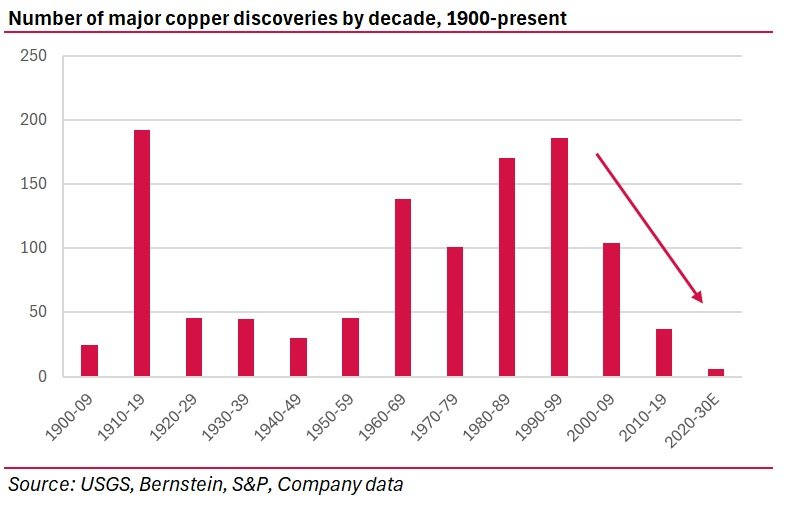
It’s not only that we’re finding fewer projects, it’s that we’re spending billions of dollars looking for them but not finding very much to show for it. And, sometimes when we do find major projects, NIMBYism means that we can’t bring them into production.
And finding copper is only the start. S&P Global estimates that the average copper mine now takes 17.5 years to move from discovery to production. So even if today’s record copper prices trigger an exploration boom, it could be 2040 before considerable new mine supply arrives.
This shortage of new discoveries feeds into another feature of the copper industry at the moment; declining grade. The average grade of copper being processed (head grade) in the industry has declined from just shy of 1% in the late-1990s to c.0.64% now. That’s a 33% decline.
That’s important. But what’s more worrying is that the average reserve grade has declined from a high of 1.06% in the late-1980s to c.0.53% now, a 50% decline.
When we’re mining a higher head grade than our average reserve grade, we call it high grading. And the industry has now been effectively “high grading” since the mid-1990s.
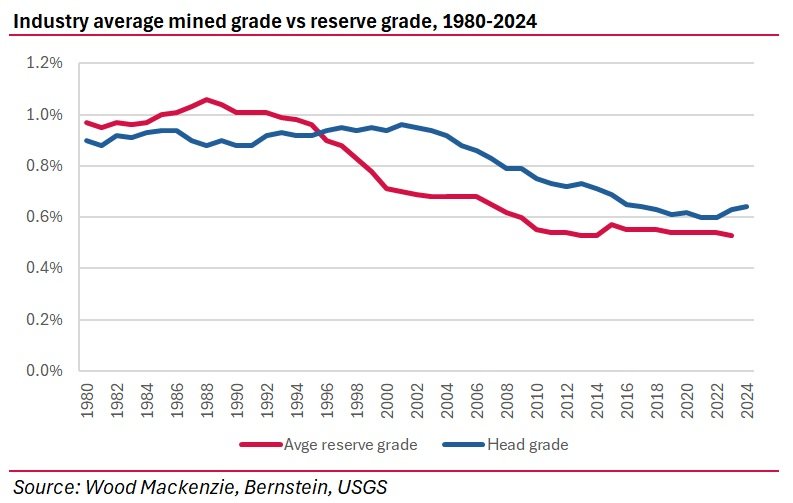
But the key thing about the declining grade argument is that it doesn’t mean that we’re running out of copper, in my view. What it means though is that we need to mine more copper ore to produce the same amount of copper metal as we used to. And we need to mine a lot more of it if we want to produce more metal.
And if we have to shift more material then our capex for projects is going to increase, as will our capex per tonne of production.
And, indeed, that trend is exactly what we’re seeing in the industry at the moment. The chart below shows the increase in capital intensity from US$7,000/t (US$2.50/lb) of CuEq at a 15% IRR in the 2000s to US$25,000/t (US$4.75/lb) for recent projects.
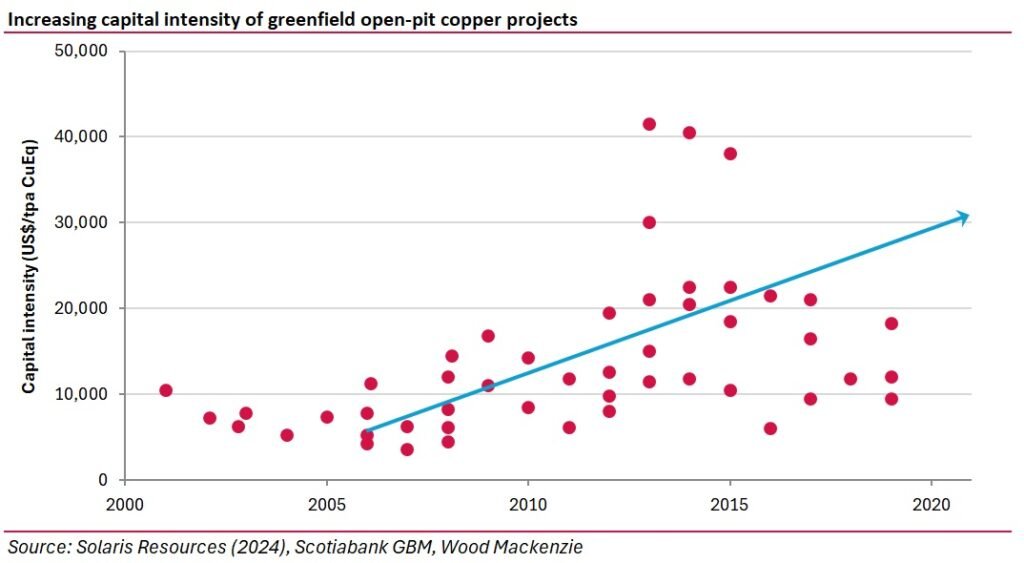
But, worse than that, is that companies are massively underestimating the capital intensity of many projects. In its 2025 results presentation Anglo American showed a chart highlighting how far out the industry has been on its estimates of capital intensity. It suggested that the industry estimated capital intensity of new projects at US$19,000/t, but projects actually built since 2010 had averaged over 50% more at US$29,000/t. That’s quite a mistake.
Now, it won’t be a surprise to most analysts that mining companies are systemically underestimating the capital cost of new projects. But the magnitude of the underestimation is a surprise, in my view. I normally use a 10-15% premium on a company’s capital cost estimate in my models, but not 50%!
And the magnitude of capex and capital intensity has a big impact on the incentive price required for new projects. And that’s what I want to talk about next.
What price does copper need?
So the incentive price for a new project is the price that’s required to justify the funding of a new project that will make an economic return over the life of that project. It’s normally a feature of both the capital and the operating costs, and most analysts assign a 15% return as the minimum return that an investor will need to justify allocating funds.
In a mature industry we tend to use the operating cost curve to define where price support exists. But in an industry which is supply constrained, I find incentive prices much more important. And, increasingly now, analysts are starting to plot incentive price curves, analogous to cost curves.
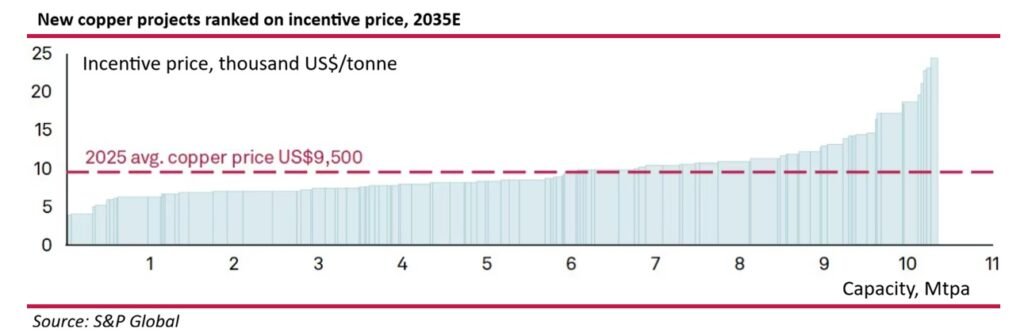
S&P Global estimates that the median incentive price for new projects expected to be in production in 2035E is c.US$8,500/t. That’s what is calculated at the moment, based on disclosed capex for those projects.
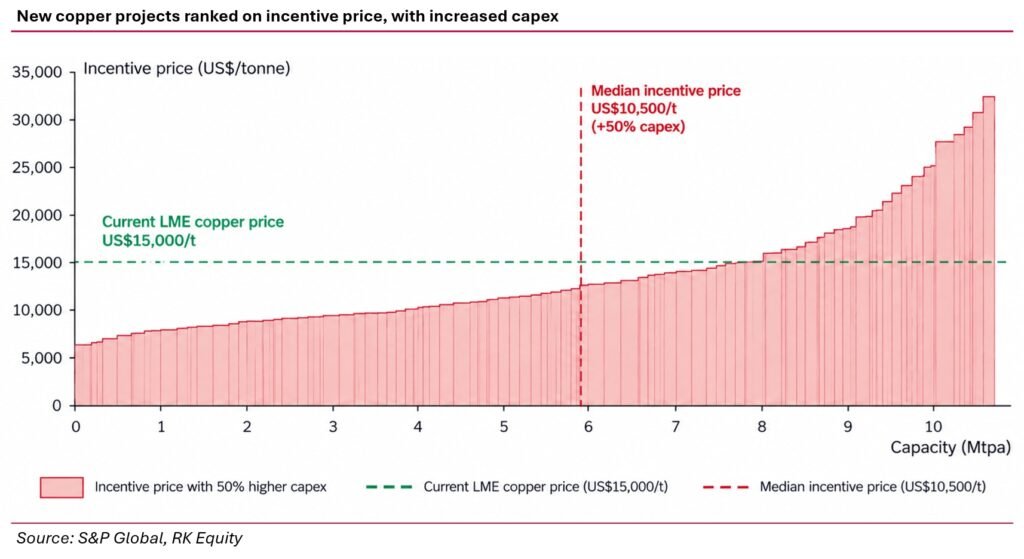
If we assume that capex is 50% higher than that assumed by the mining companies developing those projects, then the median incentive price (corrected for mine life, sustaining capex, returns and royalties) would probably rise to c.US$10,500/t with a range from US$6,000/t for the lowest-cost projects to US$30,000/t for the highest-cost.
The problem with $15,000 Copper
But the problem with an incentive price argument is that eventually you reach the incentive price.
The irony is that the higher copper prices go, the less compelling the shortage argument becomes. Higher prices don’t just reward existing producers. They improve project economics, extend mine lives, encourage brownfield expansions, increase exploration spending and stimulate scrap supply. At some point price stops being evidence of scarcity and starts becoming the mechanism that solves it.
And, as you can see from the chart above, current prices are above the median incentive price. At US$15,000/t, roughly 8Mtpa of the prospective project pipeline sits below the incentive-price threshold. That doesn’t mean 8Mtpa will be built – permitting, financing, execution and depletion at existing mines still matter enormously. But it does mean that price is no longer the principal obstacle to bringing a very substantial quantity of prospective supply into production.
Of course, the industry may be saved by the planning bottleneck. But it also may not be. Measures are underway in many countries to accelerate permitting. Will they work? I don’t know. But we can hope.

High prices also tend to help with brownfield development, much of which is not caught up in long-run supply forecasts, as well as secondary copper supply.
And importantly, we don’t have to wait 17.5 years for all of that supply response. Higher prices can extend existing mine lives, convert resources into reserves, incentivise brownfield expansions and increase secondary supply considerably faster than they can turn a new discovery into a mine.
I’m not ringing the bell on copper. But I am saying that around these extraordinarily high copper prices, the incentive price argument starts to work in reverse.
And then there’s the inventory problem…
Which kind of brings us back to where we started.
Copper bulls have suggested that we should ignore the rising inventory situation because the market has been fixated on the enormous shortage that’s coming years from now.
But is it coming?
If the better way to think of copper is through incentive pricing rather than a forecast deficit which may never happen, then rising inventories matter again.

At the moment the copper market is therefore sending two very different signals. The long-term signal – deteriorating grades, discoveries and capital intensity – says copper needs to be structurally more expensive. But the short-term signal – rapidly rising inventories – says copper isn’t particularly scarce today. At US$10,000/t those two observations can comfortably coexist. At US$15,000/t, the tension between them becomes much harder to ignore.
…and the near-term macro outlook
None of this would concern me quite so much if the global economy was accelerating strongly.
But with growth risks increasing, copper is entering a less certain macro environment with elevated inventories and a price already well above the incentive price for new supply.
I talked about copper being called Dr Copper, a bellwether for the global economy. Well, when the global economy falls over, copper tends to as well.
What does this mean for copper?
I’m not a copper bear.
I continue to believe that the industry faces a genuine scarcity problem. Fewer discoveries, declining grades, and increasing operating and capital costs mean that, in my view, copper needs to trade at structurally higher prices than it has done historically.
But I do think that prices have over-run in the near-term. Weaker macro conditions, high inventories and my scepticism that the enormous structural deficits currently being forecast will materialise as advertised are what lead me to that conclusion.
And I would suggest that the greatest danger in commodities isn’t failing to recognise scarcity; it’s forgetting that price is the mechanism that can fix that scarcity.

What does this mean for stocks?
Well, as you can probably gather, I remain a big believer in the copper scarcity argument. Which means that we need to add new copper projects as a matter of urgency. In previous downcycles, I’ve seen juniors continue to add value at the drill bit.
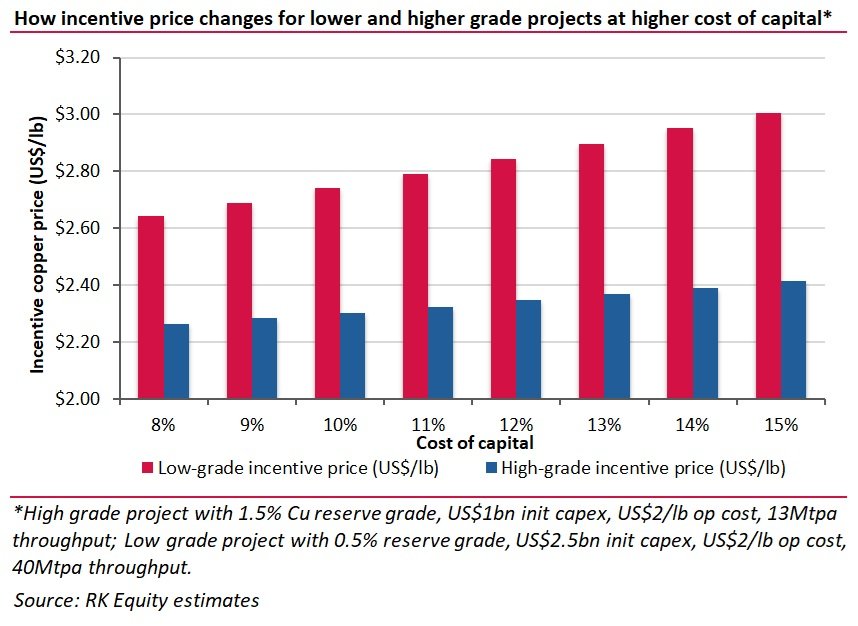
However, I do have a preference. It’s for companies with high grade discoveries (resource grades of north of 1% copper (not CuEq)) and bite size capex, below US$1bn. I’d be steering clear of large porphyry projects with lower grades and large pre-production capex. As the cost of capital rises, their incentive prices rise much faster than those of smaller, higher-grade projects. That makes them progressively harder to finance – particularly in a weaker copper price environment.
For copper producers and copper metal, I’d be short into this environment. Not because I don’t believe in copper in the medium to long-term. But simply because I believed in copper into the long-term in the GFC as well, but it didn’t stop the commodity and copper producers cratering. If it happened then it could easily happen now, in my view. A compelling long-term scarcity story doesn’t (unfortunately) protect investors from the cycle!